
The Prose Discourse Literary Style consists of different types of segments organized in a logical hierarchy. Segments at one level of the hierarchy usually contain one or more segments of the next lower level of the hierarchy. As we study through a text, we can identify changes from one level or segment to another by changes in time, place, people, conversation, activity, or topic.
Significant changes indicate movement from one level of the hierarchy to another level. Subtle changes usually indicate movement from one segment to another within the same level of the hierarchy. Higher levels of the hierarchy exhibit greater differences between levels, while the lower levels exhibit smaller differences between levels.
Hierarchy of Prose Discourse Segments
Testament
- The Bible has two testaments: the Old Testament (OT) and the New Testament (NT).
Book
- Each testament of the Bible consists of books, such as Genesis, Exodus, Matthew, Mark, and so on.
Division
- These are major parts of a book, distinct from each other based on content, focus, or structure. Examples includeGenesis 1-11, which is focused on 4 historical events, while Genesis 12-50 is focused on 4 historical people. Some NT letters have two divisions, like Ephesians: doctrine (Chapters 1-3) and practice (Chapters 4-6). Not all books of the Bible have divisions.
Section
- Sections are subdivisions, based on criteria similar to a division. The four events in the first division of the book of Genesis (Chapters 1-11) are four sections (Creation, Fall, Flood, Tower of Babel). The four people in the second division of the book of Genesis (chapters 12-50) are also four sections (focused on Abraham, Isaac, Jacob, Joseph).
- Sections can be found in all but the smallest books of the Bible.
Pericope (KEY)
- A pericope is a segment of text that is usually part of a larger text. The pericope has one theme that forms one coherent unit of thought that may be related to the pericopes before and after it, but is not dependent on those pericopes for its message.
- They are usually a lesson or sermon-sized passage with one theme to which all other smaller segments (listed below) in the pericope are directly related. Students and teachers of the Bible should focus on one complete pericope at a time in their studies and lessons.
Paragraph or Proposition
- Has one topic that supports or explains something about the theme of the pericope it is found in.
- A paragraph consists of one or more sentences with one sentence that identifies the topic of the paragraph, and other sentences that support or explain that topic.
- A proposition consists of multiple paragraphs with the same topic that support or explain something about the theme of the pericope.
Sentence
- A sentence expresses a complete statement, question, exclamation, or command that supports or explains something about the topic of the paragraph it appears in. It has a subject (what the sentence is talking about) and a predicate (tells us something about the subject of the sentence).
- A compound sentence combines two or more independent clauses using a coordinating conjunction (and, but, or, so, for, nor, yet) or a semicolon.
- A complex sentence combines an independent clause with one or more dependent clauses.
Clause
- A group of words that includes a subject and a verb, functioning as a member of a compound or complex sentence. Clauses are either:
- Independent – can stand on its own as a complete sentence that expresses a complete thought.
- Dependent – can not stand on its own as a complete sentence and depends on another clause to form a complete sentence.
- Can be one point in a list.
Phrase/Term
- One or more words that express a thought but are dependent on (and usually part of) a clause or a sentence.
- Can be one point in a list.
Prose Discourse Segmentation Process
There are basically three ways to segment a Prose Discourse passage:
- On a computer, using a word processor or Bible study software like Logos.
- Online, using an app like “ScriptureMARK” by Blue Letter Bible
- By hand, using a pencil and paper
Pericopes are the key to this segmentation process because they contain one coherent theme or unit of thought, ideal for studying, teaching, and preaching. Therefore, your study passage should focus on one complete pericope.
- It is vitally important to understand the literary context 1 of the passage you are studying, including all the segmentation levels of the study passage, and the pericopes before and after the study passage.
- Paragraphs, sentences, clauses, and phrases within your study passage provide details for the theme of that passage.
Book Study
If you are going to study or teach through a book of the Bible, read the whole book. As you are reading:
- Complete a Visceral Observation study of the book.
- Identify where each pericope in the book starts and ends.
- Add a short sentence as a heading above of each pericope that expresses the main idea of that pericope. This heading should be indented by two tab stops.
Go through the book again to look for and identify sections, then divisions.
Sections are made up of one or more pericopes whose themes are closely related to each other. Identify those points in the book where a pericope has a significantly different theme, time, place, people, conversation, or activity from the previous pericope. This probably indicates the start of a new section.
Add a short sentence as a title for each section that expresses the main thought of that section, just above the heading of the first pericope of every section. This title should be indented 2 by one tab stop.
Divisions are made of one or more sections whose content is closely related to each other. Identify those sections in the book where a section has significantly different content, focus, or structure from the previous section. This probably indicates the start of a new division.
Remember, not all books of the Bible have divisions, so don’t force a Division where there isn’t one.
Add a short sentence for a division heading that expresses the main idea of the division, just above the heading of the section with the new content.
Pericope Study
To study a pericope, read through the whole pericope. (If you are doing a book study, you’ll do this for every pericope in the book as you progress through your study.)
As you are reading the pericope, complete a Visceral Observation study. (If you already did a Visceral Observation study of the book, you are now looking for any new details you may have missed previously.)
Read and consider a few of the pericopes before and after your study pericope to understand the context of your study pericope.
Paragraphs are usually the main points of a pericope (especially for a lesson or sermon).
Paragraphs are made up of one or more sentences whose subjects are closely related to each other and to the topic of the paragraph. Identify those points in the pericope where a sentence has a significantly different subject, time, place, people, conversation, or activity from the previous sentence. This probably indicates the start of a new paragraph.
Add a short clause for a paragraph heading that expresses the main idea of the paragraph just above the sentence that is significantly different than the previous sentence. This heading should be indented by three tab stops.
Update the work you have done so far if the context of your study passage indicates any changes that may be needed (either your segmentation or the headings you created).
NOTE: At this point, your segmentation and headings are preliminary. You might change them based on what you learn as you continue your study.
The headings you added to the divisions, sections, pericopes, and paragraphs form the study passage’s outline. The following outline is from the headings created for the first two sections of 1 Peter (1 Peter 1:1-2:10).
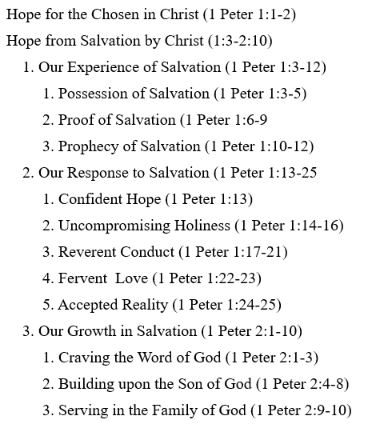
The format of this outline is:
- Section headings
- [tab] Pericope headings
- [tab] [tab] Paragraph headings
Notes:
- There are no divisions in this outline because 1 Peter doesn’t have any. Since there are no divisions, each heading (in the text and the outline) has one less tab stop for indentation.
- There are two sections in 1 Peter 1:1-2:10.
- The first section has no pericopes.
- The second section has three pericopes
- The first pericope has three paragraphs
- The second pericope has five paragraphs
- The third pericope has three paragraphs
Of course, if you are not doing a book study, your outline will consist only of a pericope heading with paragraph headings indented under it, which would make a good lesson or sermon outline.
Segmentation of the Paragraph
Since we are striving to understand what the Bible text is saying by tracing the author’s flow of thought, we need to identify each thought. To do that, we need to continue with a Segmentation of each paragraph.
This part of the Segmentation process is more art than science (compared to what you did so far). You will be deciding which sentences to leave intact and which ones to segment into their clauses and/or phrases.
Like the higher-level segments, you need to indent any segment that is dependent on or subordinate to a higher-level segment. However, these segments do not get a title heading.
Usually, clause and phrase segments are details and usually follow after/below the segment they are dependent on. However, sometimes they come before/above the segment they are dependent on.
Here is an example of indented segmentation to the Phrase/Term level:
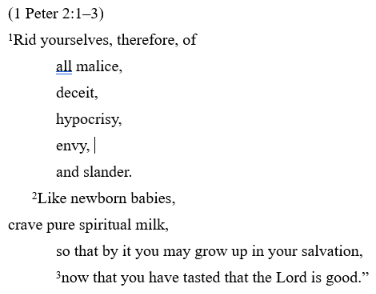
Explanation of 1 Peter 2:1–3 segmentation:
- (Note: the letters after a verse number indicate the line or clause within that verse: “a” = the first, “b” = the second, etc.)
- Verse 1a is aligned at the left margin, and verses 1b-1f are indented because they are subordinate to 1a.
- Verse 2a is a dependent clause to verse 2b. For that reason, 2a is indented and 2b is not.
- Verse 2b is not indented because it expresses the force of a command, which raises its level of importance.
- So that 2a is not mistaken as a subordinate of verse 1a, verses 1b-1f are indented by extra tabs, and verse 2a is indented by one more tab than 2b, so it is visually separated from the list in v1 and is instead related to 2b.
- 2c and 3a provide details for 2b, so they are indented below 2b.
Compare this indented segmentation format above with the usual paragraph format below (ESV):
“So put away all malice and all deceit and hypocrisy and envy and all slander. Like newborn infants, long for the pure spiritual milk, that by it you may grow up into salvation— if indeed you have tasted that the Lord is good.”
As you can see by comparing the segmentation format and the paragraph format, the segmentation format draws your attention to several things that are buried in the paragraph format. Segmentation helps you see the author’s flow of thought, including details of key thoughts. For example:
- Right off the bat, you can see a list of things we are to “rid ourselves” of. By seeing the words listed separately, we are prompted to look them up and find out exactly what it is we are to “put away”.
- Not only that, we clearly see in 2b that we are to “crave” for something instead (because it stands out from the rest of the passage), and also see both its result (2c) and the reason why we should (3a). We can also see an example of what it means to “crave pure spiritual milk” in 2a.
- Because the main thoughts in 1a and 2b are both aligned with the left margin, thus juxtaposed to each other, we see they are two parts of the same instruction: “put away” and instead “long for”. Too often, these are taught as two separate concepts when in reality they are two parts of the same command.
- We also see that the artificial segmentation using verse numbers does not help us see the author’s flow of thought like the segmentation format does.
Published Bibles are usually formatted by verses (KJV, NASB) or paragraphs (ESV, NIV) and often have pericope headings. But as you can see, there is a lot more depth to the passages than can be readily discerned by using the segmentation format.
If you want to clearly know what a Bible passage says, segmentation is the way to go. You benefit not only from the end product but mostly from the process of segmenting the passages yourself.
(FYI, more information about segmentation (also known as Phrasing) is available at: https://doxa.billmounce.com/Phrasing-1.pdf)
See also the tool “ScriptureMark“
NOTE: There are some Bible translations that are published in a moderately segmented format. That is a convenient shortcut, and provides some benefit to your study, but not as much of a benefit as when you segment the study passage yourself. Examples of Bibles in a moderately segmented format include: Berean Standard Bible, Good News Bible, New International Reader’s Version (1998), and Word Come Alive.
 Thessalonian Faith