
(43.11a)
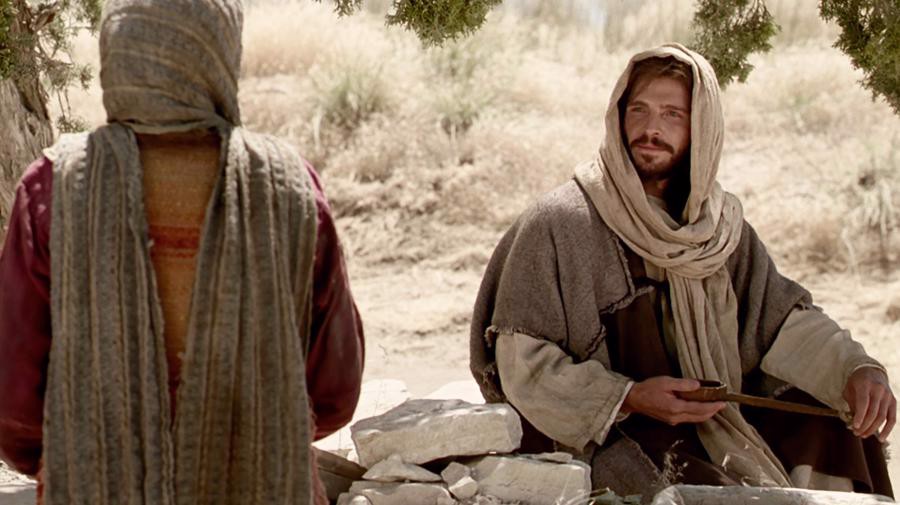
Whoever drinks the water I give him will never thirst. Indeed, the water I give him will become in him a fount of water springing up to eternal life.”
(John 4:14)
For this week’s study:
- Read John 4:1-26 several times using your Bible, and the two translations provided below, to understand the boundaries, content and flow of the passage.
- Then, explore the “Study Guide” and “Study Resources” provided below.
Read the Passage
Berean Standard Bible
(BSB)
Jesus and the Samaritan Woman
4 <1>When Jesus realized that the Pharisees were aware He1 was gaining and baptizing more disciples than John <2>(although it was not Jesus who baptized, but His disciples), <3>He left Judea and returned to Galilee.
<4>Now He had to pass through Samaria. <5>So He came to a town of Samaria called Sychar, near the plot of ground that Jacob had given to his son Joseph. <6>Since Jacob’s well was there, Jesus, weary from His journey, sat down by the well. It was about the sixth hour.2
<7>When a Samaritan woman came to draw water, Jesus said to her, “Give Me a drink.” <8>(His disciples had gone into the town to buy food.)
<9>“You are a Jew,” said the woman. “How can You ask for a drink from me, a Samaritan woman?” (For Jews do not associate with Samaritans.)3
<10>Jesus answered, “If you knew the gift of God and who is asking you for a drink, you would have asked Him, and He would have given you living water.”
<11>“Sir,” the woman replied, “You have nothing to draw with and the well is deep. Where then will You get this living water? <12>Are You greater than our father Jacob, who gave us this well and drank from it himself, as did his sons and his livestock?”
<13>Jesus said to her, “Everyone who drinks this water will be thirsty again. <14>But whoever drinks the water I give him will never thirst. Indeed, the water I give him will become in him a fount of water springing up to eternal life.”
<15>The woman said to Him, “Sir, give me this water so that I will not get thirsty and have to keep coming here to draw water.”
<16>Jesus told her, “Go, call your husband and come back.”
<17>“I have no husband,” the woman replied.
Jesus said to her, “You are correct to say that you have no husband. <18>In fact, you have had five husbands, and the man you now have is not your husband. You have spoken truthfully.”
<19>“Sir,” the woman said, “I see that You are a prophet. <20>Our fathers worshiped on this mountain, but you Jews say that the place where one must worship is in Jerusalem.”
<21>“Believe Me, woman,” Jesus replied, “a time is coming when you will worship the Father neither on this mountain nor in Jerusalem. <22>You worship what you do not know; we worship what we do know, for salvation is from the Jews. <23>But a time is coming and has now come when the true worshipers will worship the Father in spirit and in truth, for the Father is seeking such as these to worship Him. <24>God is Spirit, and His worshipers must worship Him in spirit and in truth.”
<25>The woman said, “I know that Messiah” (called Christ) “is coming. When He comes, He will explain everything to us.”
<26>Jesus answered, “I who speak to you am He.”
Word Come Alive
(WCA)
(An extended translation)*
Jesus and the Samaritan woman
<1>Jesus discovered that the Pharisees had heard he was gaining and baptizing more followers than John. <2>However, it was Jesus’ apprentices, not Jesus himself, who baptized. <3>So he left Judea and returned north to Galilee.
<4>Some Jews avoided Samaria because there was a deep hatred between Jews and Samaritans, but Jesus sensed a divine urge to go through Samaria on his way. <5>As he walked through that province, Jesus came to the town of Sychar, which was near the plot of land Jacob had given to his son Joseph many years before. <6>Just outside Sychar was Jacob’s well. Jesus was tired from all his walking, so he sat down by the well to rest. It was about midday.
<7>It wasn’t long before a woman from that area came to draw water from the well. Jesus set aside the custom that Jewish men, especially rabbis, don’t talk to women in public. He began a conversation with her, ‘Please can you give me some water to drink?’ <8>His apprentices weren’t with him, because they’d gone into the nearby town to buy food.
<9>The woman replied, ‘I don’t understand. You’re a Jewish man and I’m a Samaritan woman. How can you ask me to give you water to drink?’ (Jews normally don’t have anything to do with Samaritans.)
<10>Jesus began to spark her curiosity. He answered her, ‘If you knew the gift of God and who is asking you for a drink, you would be asking me for fresh, living water. I would have given you that.’
<11>The woman was taken aback by Jesus’ comment. ‘Sir,’ she answered, ‘You haven’t even got a bucket to draw water from this deep well. Where can you get this “fresh, living water” from? <12>Are you more important than our ancestor Jacob, who gave us this well and even drank from it himself, just as his sons and cattle did?’
<13>Jesus explained more to her, ‘Everyone who drinks this physical water from the well will have their thirst relieved only for a little while. They will soon be thirsty again. <14>But whoever drinks the spiritual water of life that I will give to them will never be thirsty again. In fact, the spiritual water I will give them will become a fresh spring that bubbles over into eternal life. Everyone who receives this water will have their deepest spiritual longings satisfied now and for ever.’
<15>‘Sir,’ the woman responded immediately, ‘I want water like that! Give it to me now so I won’t ever get thirsty again. Then I won’t need to keep on coming here to draw water from the well.’
<16>Jesus moved the conversation on, as he wanted the woman to face up to the realities of her life. He therefore challenged her, ‘Go and fetch your husband.’
<17>‘I, er, haven’t got a husband,’ the woman answered him.
Jesus spoke to her firmly but patiently, ‘Yes, you’re right in saying you haven’t got a husband. <18>In fact, I know you’ve had five husbands, and the man you’re now living with isn’t your husband. You’ve spoken the truth.’ The woman was amazed to discover that Jesus knew such a lot about her. She felt uncomfortable as to where the conversation might lead, so she tried to change the subject, directing the conversation away from herself.
<19>She went on, ‘Sir, I can see from your insight that you are a prophet. Ordinary people don’t talk about things as you do. <20>Our ancestors worshipped on this mountain, Mount Gerizim, but you Jews say we must worship in Jerusalem.’
<21>Refusing to be sidetracked, Jesus spoke more about the woman’s deepest need, to worship God. He replied, ‘Woman, trust me, it isn’t where you worship that matters; it’s how and what you worship that is important. A time is coming when you’ll worship the Father neither on this mountain nor in Jerusalem. <22>You Samaritans worship what you do not know, but as Jews we worship what we do know, because salvation comes from the Jews. <23>I tell you that a time is coming—and has actually now come—when those who really worship the Father will worship him with wholehearted devotion in spirit and in truth. That is the kind of worshippers the Father is looking for. <24>God is not something visible or physical. He is spirit—invisible and spiritual—and those who worship him must do so in spirit and in truth. True worshippers need the help of the Holy Spirit to worship him in this way.’
<25>The woman answered him, ‘I know that one day the Messiah, the Christ, will come. When he eventually arrives, he will explain everything clearly to us.’
<26>Jesus finally disclosed who he was, ‘I, the very One who is talking to you right now, am he. I am the Messiah.’
* Words in italics are not translated from the original Greek text. They have been added to explain and at times apply the text, much as a preacher does on a Sunday or notes do at the foot of the page in a study Bible. These additions are integrated with the text itself, and are in italics, so readers can see what has been explained, changed or added.
Study the Passage
Study Guide
► Read and fill in the blanks in the following Bible verse:
“For God did not send His Son into the world to ____________ the world, but to ________ the world through Him.” (John 3:17)
In our study passage (John 4:1-26), Jesus spoke to a woman about two topics:
► In John 4:7–15, the topic was water.
- Describe the water the woman was focused on.
- Describe the water that Jesus was focused on.
► In John 4:16-26, the topic was relationships.
- Describe the relationships the woman had experienced.
- Describe the relationship Jesus offered the woman.
► Based on John 3:17 (first question above), there are two reasons God the Father could have sent His Son Jesus into the world to do.
- Which one seemed to be Jesus’ approach with the woman of Sychar?
- What makes you think that?
Study Resources
To learn more about this study passage, go to
https://www.bibleref.com/John/4/John-4-1.html. Read the commentary of each verse in the study passage. (Also read the Context Summary and the Chapter Summary.)
If you have any questions about this passage, type the verse reference or your question in the search box at the top of
https://www.gotquestions.org/ and explore the results.
If you have a study Bible, read the footnotes and study notes and see how they help you understand this passage.
 Thessalonian Faith