
Discipleship is a relationship ministry practiced through three Roles: Mentor, Partner, Apprentice.1
Over the course of time, every mature disciple of Jesus will have experienced and/or practiced all three roles. Sometimes a mentor will practice more than one role in a mentee’s lifetime (like Barnabas to Paul). However, no mentor is an expert in any one role, let alone all three roles, so it is common (or should be) for people to have more than one mentor in their lifetime.
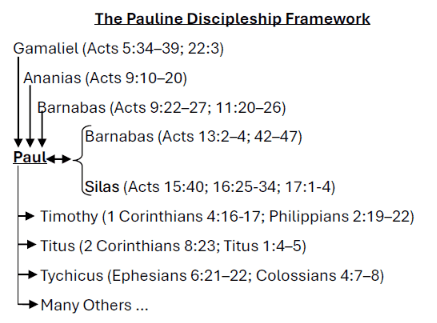
This diagram identifies participants in all three roles as they related to the apostle Paul.
- The three people named above Paul’s name were Mentors to Paul
- The two people named next to Paul’s name were Partners with Paul
- The three people named below Paul’s name were Apprentices of Paul
The people listed here were not the only people related to Paul in his discipleship experience, but they were key people in Paul’s life and key examples for us to learn from.
Paul’s Mentors
A mentor is an experienced and trusted adviser2 who guides, trains, and counsels less experienced individuals. Mentoring involves a relational process between a more knowledgeable or skilled person and a learner, characterized by intentionality and a focus on the mentee’s growth3. Effective mentors not only transfer skills but also impart values and practices, fostering both professional and personal development4.
NOTE: Paul was originally known by the name “Saul” (Acts 13:9).
Mentors are listed below in chronological order of engaging Saul. Usually, the roles are initiated in the order of Assimilation, Academic, then Activation, though in Saul/Paul’s case the order was different. Everyone needs to grow in and practice all three roles throughout their lifetime. All mentors must have skills in and practice all three roles, but are inevitably focused on and stronger in one role over the others, hence the need for multiple mentors.
Paul started out as an apprentice under the mentorship of:
Gamaliel was Paul’s Academic Mentor. He taught Paul the word of God. (Acts 9:22–27; 11:20–26; 13:2–4)
- An Academic Mentor helps you grow in your knowledge of Jesus. (Ephesians 4:12-13)
Ananias was Paul’s Assimilation Mentor. He helped Paul get established in the family of God. (Acts 9:10–20)
- An Assimilation Mentor helps you grow in your relationship in Jesus. (John 17:20–21)
Barnabas was Paul’s Activation Mentor. He prepared Paul for the work of gospel ministry. (Acts 9:22–27; 11:20–26)
- An Activation Mentor helps you grow in your service with Jesus. (2 Corinthians 5:18–20)
Paul’s Partners
The double arrow between Paul and his partners represents the fact that partners work together as a team.
Barnabas (Acts 13:2–4; 42–47)
- Barnabas not only prepared Paul for the work of ministry (as an Activation Mentor), but he also served with Paul (as a ministry partner) while Paul was getting started in his own ministry.
Silas (aka, Silvanus) (Acts 15:40; 16:25-34; 17:1-4)
- Paul first worked with Silas (Acts 15:22) when they (along with Barnabas and Judas called Barsabbas) brought news to the church in Antioch from the apostles and elders in Jerusalem regarding the circumcision of gentiles (Acts 15).
- Later, when Barnabas’ ministry with Paul was finished, Paul selected Silas as his ministry partner (Acts 15:36–41; 2 Corinthians 1:19)
Paul’s Apprentices (aka mentees)
Although these men started out as Paul’s apprentices, they quickly became partners with Paul and then carried on in their own ministry just as Paul instructed in 2 Timothy 2:1–7.
- Timothy (1 Corinthians 4:16-17; Philippians 2:19–22)
- Titus (Galatians 2:1; 2 Corinthians 8:16–17; Titus 1:4–5)
- Tychicus (Acts 20:1–5; Colossians 4:7–8)
(And many others)
Also see descriptions: “A Disciple (Mentee/Apprentice) is …”, “A Disciplemaker (Mentor) is …”, and “Personal Discipleship is …” on the Personal Discipleship page.
Footnotes:
- Role: A part or function a person fulfills within an organization or process. ↩︎
- Concise Oxford English Dictionary; Merriam-Webster, Merriam-Webster’s Collegiate Dictionary (Springfield, MA: Merriam-Webster, 1996).. ↩︎
- Gary C. Newton, Growing toward Spiritual Maturity, Biblical Essentials Series (Wheaton, IL: Crossway Books, 2004), 96–97. ↩︎
- Bill Easum and Bill Tenny-Brittian, Effective Staffing for Vital Churches: The Essential Guide to Finding and Keeping the Right People (Grand Rapids, MI: Baker Books, 2012), 71. ↩︎
 Thessalonian Faith